

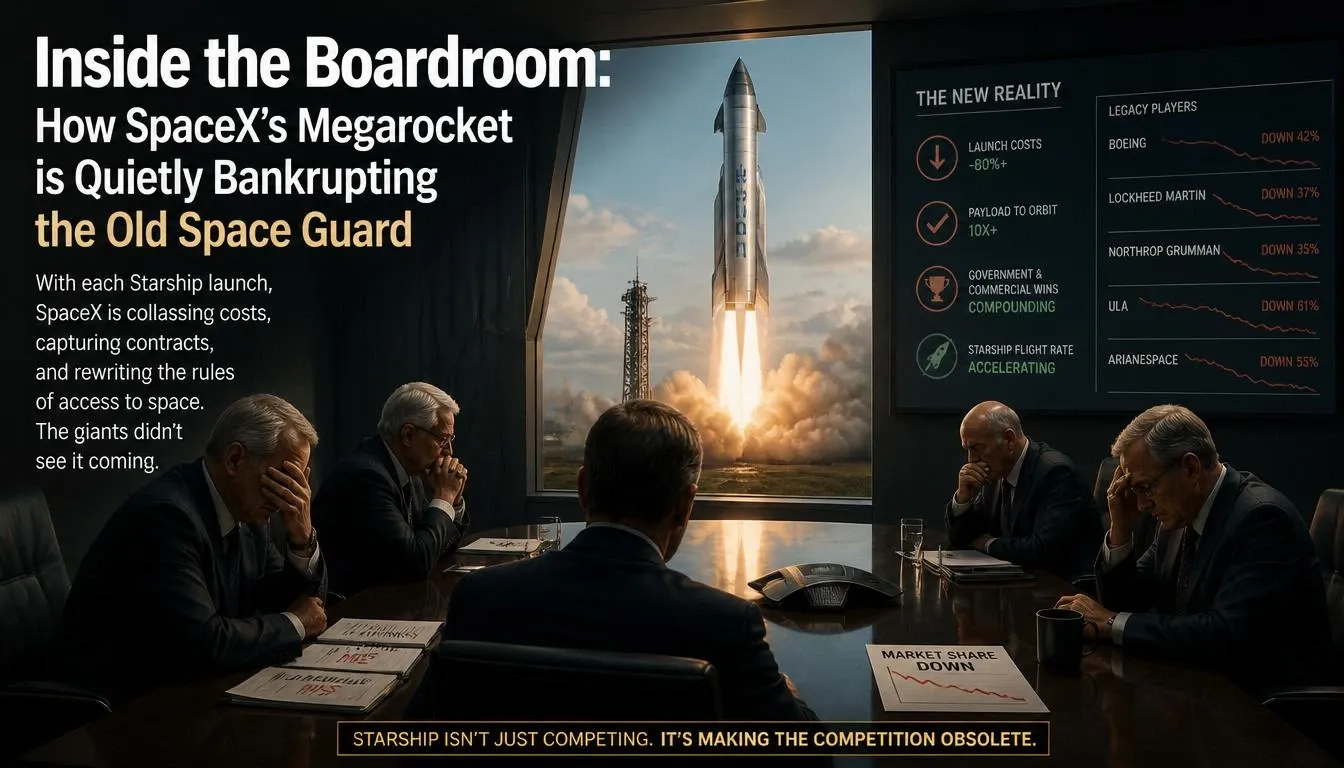
The aerospace industry is notoriously unforgiving. For decades, it was a cozy, exclusive club of government-backed titans—Boeing, Lockheed Martin, Arianespace, and Roscosmos. They dictated the terms, set the astronomical prices, and operated on cost-plus contracts that virtually guaranteed profit, regardless of inefficiency. But behind the closed doors of today’s corporate boardrooms, a cold realization is setting in.
SpaceX’s Starship—the largest and most powerful flying machine ever constructed—is not just a technological marvel; it is an economic weapon. And it is quietly bleeding the "Old Space Guard" dry.
In this comprehensive analysis, we explore the stark economic realities of the new space race, the existential crisis facing legacy aerospace companies, and what it means for the future of orbital economics. If you are tracking the future of sovereign tech investments, understanding this shift is critical. (Learn more about our mission on our About page, explore deep tech trends on our Blog, and feel free to reach out via our Contact page).
The Dawn of the Megarocket Era: Ground Zero in South Texas
To understand the scale of the disruption, you must look at Boca Chica, Texas. This quiet coastal strip, now famously known as Starbase, is the epicenter of a manufacturing revolution. For regional economic impacts, the transformation of South Texas into a spacefaring hub mirrors what Silicon Valley did for software in the 1990s. The ripple effects are being felt from the Space Coast in Florida to the halls of the Pentagon in Washington, D.C.
SpaceX isn't just building a rocket; they are building a factory that builds rockets. The iterative design process at Starbase stands in stark contrast to the traditional aerospace model. Old Space companies spend decades and billions of taxpayer dollars in the design phase before bending metal. SpaceX builds, launches, blows up, learns, and builds again in a matter of weeks, a methodology akin to Agile software development.
This agility is the core reason why legacy companies are struggling to compete. You cannot out-innovate a competitor that iterates ten times faster than you do.
Why Starship Changes Everything
Starship is designed to be fully and rapidly reusable. While the Falcon 9 revolutionized the industry by landing its first stage, Starship aims to land both its Super Heavy booster and the upper stage spacecraft.
The economic implications of full reusability cannot be overstated. When you throw away a multi-million-dollar rocket after every flight, space access remains the domain of billionaires and governments. When a rocket operates like a commercial airliner, the cost of accessing space plummets to near the cost of the propellant. Read our related thesis on The Commoditization of Launch Hardware.
The Cost Comparison: A Data-Driven Reality Check
To visualize the magnitude of this shift, consider the current estimated launch costs across the industry:
| Launch Vehicle | Estimated Cost per Launch | Reusability | Primary Focus |
|---|---|---|---|
| SpaceX Starship | ~$10M – $100M+ (Goal: <$10M) | Fully Reusable | Super heavy-lift, interplanetary travel, ultra-low cost commercial access. |
| ULA Vulcan Centaur | ~$110M+ | Expendable (Partial planned later) | High-reliability, national security payloads. |
| Arianespace Ariane 6 | ~$90M – $120M | Expendable | European sovereignty and institutional payloads. |
| Boeing SLS (NASA) | ~$2.5B – $4B+ | Expendable | Deep space exploration, human-rated Artemis missions. |
Sources: NASA OIG Reports, Industry Analyst Projections via Bloomberg.
The Old Space Guard: A Legacy Under Siege
Let’s peer inside the boardrooms of the legacy giants to understand the panic setting in.
Boeing and the SLS Dilemma
Boeing has been the darling of the U.S. aerospace sector for nearly a century. As the primary contractor for NASA's Space Launch System (SLS), Boeing relies heavily on the cost-plus contracting model. This means the government covers all development costs and guarantees a profit margin on top.
However, the SLS is estimated to cost between 2.5billionand2.5billionand4 billion per launch, according to a blistering NASA Inspector General report. It is completely expendable. In a world where SpaceX can launch a vehicle with double the thrust of the SLS for less than a tenth of the cost, the political justification for Boeing's mega-rocket is rapidly evaporating. Taxpayers and lawmakers are beginning to ask hard questions, leading to a precarious financial outlook for legacy defense divisions. For a deep dive into defense contracting, check our article on The Economics of Defense Contracting.
ULA's Vulcan Centaur: Too Little, Too Late?
United Launch Alliance (ULA), a joint venture between Boeing and Lockheed Martin, recently debuted the Vulcan Centaur. While Vulcan is a capable and highly reliable rocket tailored for U.S. Space Force missions, it is fundamentally an expendable vehicle with a starting price north of $110 million.
ULA’s boardroom strategy relies heavily on the fact that the U.S. military requires "assured access to space" through multiple providers. But as Starship matures, the sheer economic disparity will force military procurement officers to rethink how they award contracts. You can read more about similar enterprise disruptions in our recent piece on The Cloud Wars.
The Economics of Reusability: 5 Ways SpaceX is Winning (Listicle)
To understand why bankruptcy is a whispered word in legacy aerospace, we must break down the economic moat SpaceX has built. Here are the top five ways the Megarocket is rewriting the rules:
- Zero-Gravity Cost Reductions: By recovering both stages, SpaceX essentially eliminates the cost of manufacturing new rocket hardware for every mission. The only recurring costs are fuel, refurbishments, and range operations.
- Payload Capacity Dominance: Starship can lift up to 150 metric tons to Low Earth Orbit (LEO) while fully reusable. This means satellite manufacturers no longer need to spend millions miniaturizing components; they can launch heavier, cheaper hardware.
- Turnaround Time and Cadence: SpaceX envisions launching Starship multiple times a day. Traditional rockets take months to integrate and prep for a single launch. See our analysis on Cadence as a Competitive Advantage.
- Vertical Integration Ecosystem: From Starlink internet terminals to the Raptor engines, SpaceX builds almost everything in-house. This cuts out the expensive web of subcontractors that plague companies like Boeing.
- Private Capital Agility: As a private company, SpaceX does not have to cater to quarterly earnings reports for Wall Street analysts. They can absorb the financial shock of a prototype exploding on the pad, treating it as a valuable data collection exercise rather than a PR disaster.
Visualizing the Ideological Divide
The struggle between SpaceX and the Old Guard is not just about technology; it is a clash of corporate ideologies.
| Old Space | The Squeeze (Market Reality) | SpaceX |
|---|---|---|
| Cost-plus contracts | Procurement Shifts | Fixed-price bids |
| Expendable hardware | Unit Economics | Full reusability |
| Lobbying-driven | Strategic Edge | Engineering-driven |
| Risk averse / Slow | Pace of Innovation | Rapid iteration |
Is Bankruptcy Inevitable for Legacy Aerospace?
The word "bankrupt" in aerospace is complex. Companies like Boeing and Lockheed Martin are deeply entrenched in the military-industrial complex. The U.S. government is unlikely to let them formally fold, as they provide critical national security assets like fighter jets and missile defense systems.
However, their space launch divisions are functionally bankrupt in terms of commercial viability. Arianespace, the European space champion, is pleading with the European Space Agency (ESA) for subsidies to keep the Ariane 6 program afloat, citing the impossibility of competing with SpaceX on price, as reported by Ars Technica.
In the short term, legacy providers will survive on government mandates that require redundant launch providers. In the long term, unless they can develop their own fully reusable architectures, their space divisions will become little more than expensive, taxpayer-funded museum pieces. We discuss this heavily in our Sovereix Market Outlook 2026.
What This Means for Investors and Sovereignty
For investors tracking the space economy, the lesson is clear: hardware is no longer the bottleneck.
With Starship driving the cost of launch toward zero, the true value shifts to what you can put in space. Orbital manufacturing, space-based solar power, asteroid mining, and mega-constellations for global broadband (like Starlink) are transitioning from science fiction to viable business models.
Furthermore, nations that rely on legacy providers are finding themselves at a severe sovereign disadvantage. Independent access to space is a cornerstone of national security. If European and Asian markets cannot match the launch cadence of South Texas, they risk ceding the orbital economy entirely to American commercial interests. Learn more about national autonomy at Sovereix Sovereignty Initiatives.
Conclusion: The Final Frontier of Corporate Evolution
SpaceX’s Megarocket is doing exactly what it was designed to do: it is making humanity a multi-planetary species by brutally optimizing the economics of leaving Earth. In doing so, it has exposed the bloated, lethargic state of the Old Space Guard.
The boardrooms of legacy aerospace are out of time. The era of the multi-billion-dollar expendable rocket is over. The Starship era has arrived, and it is taking no prisoners.