

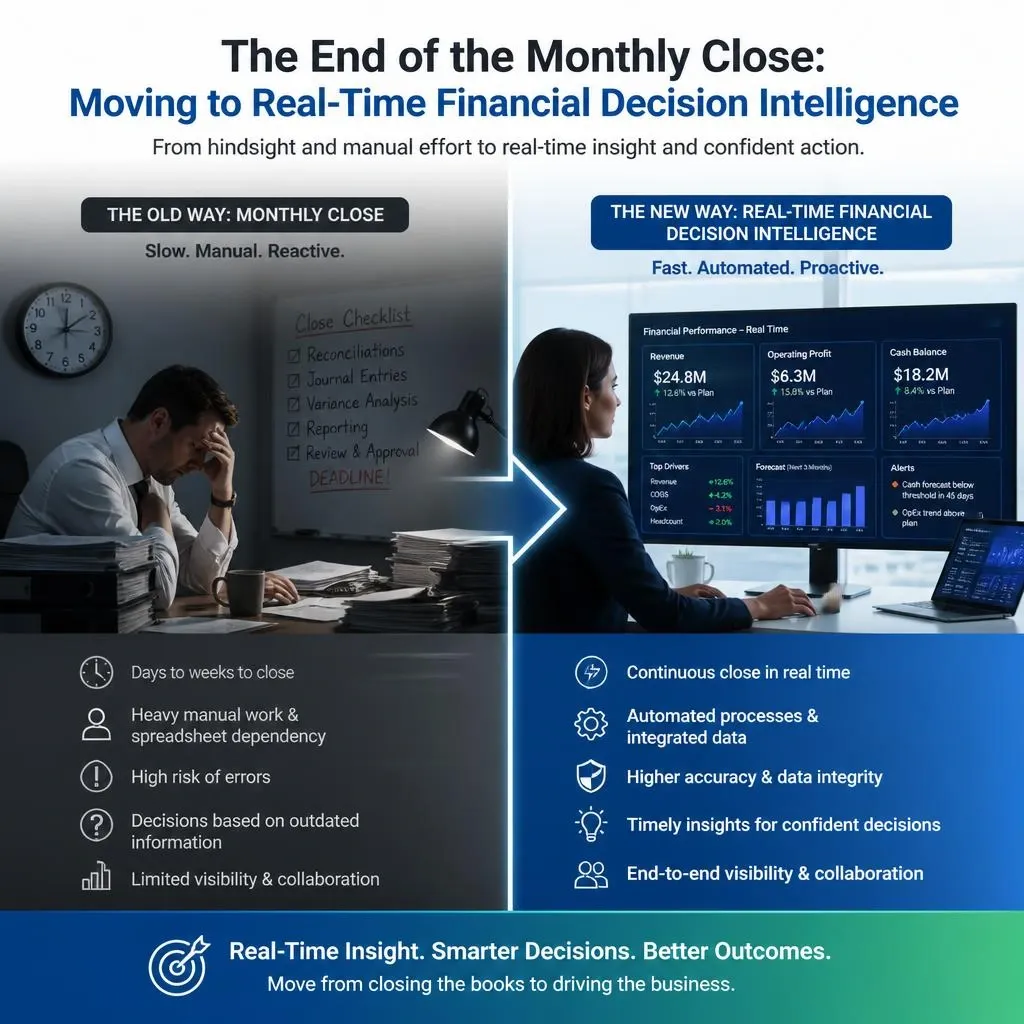
The era of static, end-of-month periodic reporting is officially behind us. For decades, finance departments have operated on a rigid cycle: waiting weeks to consolidate ledgers, reconcile accounts, and finally produce a backward-looking snapshot of the company's health.
But in today’s hyper-connected, fast-paced economy, looking backward is no longer an option.
The current trend sweeping through corporate finance is Decision Intelligence—the use of advanced, autonomous AI to generate real-time predictive models. This transformative approach allows businesses to anticipate working capital needs, identify supply chain shocks, and forecast market fluctuations before they happen.
If your organization is still waiting until day 10 of the new month to understand last month's performance, you are operating at a severe competitive disadvantage. In this comprehensive guide, we will explore why the traditional monthly close is dying, how autonomous AI is changing financial forecasting, and what you need to do to embrace continuous accounting.
The Traditional Monthly Close is Costing You More Than Time
Historically, the monthly financial close has been a high-stress, labor-intensive period. Accounting teams work late into the night, manually tracking down receipts, matching invoices, and correcting human errors.
The Hidden Financial and Human Costs
The true cost of the traditional close extends far beyond overtime pay. Relying on periodic reporting creates blind spots.
According to recent industry benchmarking, companies with slow close cycles (exceeding 7 days) report 35% higher accounting staff turnover and 25% increased recruiting costs due to sheer team burnout. Furthermore, delayed reporting is estimated to cost high-growth companies 2–3% of potential revenue because leadership lacks the timely data required to seize fleeting market opportunities.
When market conditions shift overnight—as we’ve seen repeatedly in recent global supply chain disruptions a report that is three weeks old is functionally useless.
What is Real-Time Financial Decision Intelligence?
Real-Time Financial Decision Intelligence represents a fundamental shift in how finance operates. It moves the department away from being historical record-keepers and transforms them into strategic, forward-looking advisors.
Predictive vs. Periodic: The Paradigm Shift
- Periodic Forecasting looks at what has happened. It relies on historical batch-processing, producing static reports that require manual interpretation.
- Predictive Forecasting powered by Predictive Analytics, looks at what will happen. It uses continuous data ingestion, machine learning, and multi-agent AI to provide dynamic, autonomous working capital management.
Instead of running variance analysis once a month, an AI-driven financial system continuously monitors Accounts Payable (AP), Accounts Receivable (AR), macroeconomic indicators, and internal operational data. It alerts the CFO the moment a cash flow bottleneck is predicted, not a month after the cash has already dried up.
The Autonomous AI Revolution in Financial Forecasting
The driving force behind this transformation is the evolution of Artificial Intelligence. We are moving past simple robotic process automation (RPA) into the realm of multi-agent AI systems.
How Multi-Agent AI Changes the Game
Multi-agent AI involves specialized AI agents working collaboratively to execute complex workflows. In a finance context, one agent might constantly read incoming bank feeds, another cross-references them against open invoices, and a third drafts the journal entry. Exceptions are automatically flagged and routed to a human controller for approval.
This means the work of the "close" is happening continuously, every single minute of every day. By the end of the month, the books are already reconciled. Gartner identifies this "Close Compression" as a defining trend for modern finance, drastically altering how strategic decisions are made.
5 Reasons Why CFOs Are Abandoning the Monthly Close
The transition to dynamic forecasting and continuous accounting is accelerating. Here are the top five reasons forward-thinking financial leaders are making the leap.
1. Unprecedented Close Compression
The most immediate benefit of real-time financial reporting is speed. Organizations implementing continuous close methodologies have reported reducing their month-end close time by an average of 50%. With the latest multi-agent AI platforms, mid-market companies are compressing their close cycles from an average of 6.2 days down to just 1.8 days.
2. Elimination of Workload Spikes and Burnout
The end-of-the-month scramble is notoriously toxic for finance team morale. Research indicates that organizations adopting continuous close capabilities experience an average 78% reduction in period-end workload spikes, alongside an 83% decrease in overtime. When AI handles the repetitive reconciliation, your top financial talent can focus on strategic advisory roles.
3. Predictive Cash Flow and Autonomous Working Capital Management
Working capital is the lifeblood of any business. With real-time data, AI models can autonomously manage working capital by predicting late payments from clients and dynamically adjusting procurement spending. This ensures liquidity is never compromised and allows businesses to confidently invest surplus cash.
4. Unmatched Accuracy and Compliance
Human error is inevitable in manual batch processing. AI, however, thrives on high-volume data matching. Organizations moving to a continuous close report 92% fewer post-close adjustments and a 76% reduction in compliance findings, aligning strictly with global AI compliance standards. The audit trail is instantly verifiable, ensuring absolute data integrity.
5. Empowering Agile Business Decisions
According to Deloitte research, companies utilizing real-time analytics can improve decision-making speed by 30%. Moreover, businesses leveraging real-time financial reporting tools are 33% more likely to exceed their revenue growth targets. Agility is no longer a buzzword; it is a measurable financial metric.
Visualizing the Shift: Traditional vs. Continuous Close
To truly understand the impact of real-time decision intelligence, we must compare the structural differences between legacy and modern systems.
Below is a breakdown of how the two approaches stack up against each other:
Performance Impact Dashboard (Simulated)
Average Workload Distribution (Month-End)
Building a Business Case for Your Local Enterprise
Implementing this level of automation isn't just for Fortune 500 conglomerates. Local enterprises and regional corporate hubs are rapidly adopting cloud-based AI accounting software to level the playing field. Whether you are managing supply chains in local industrial parks or overseeing regional commercial real estate portfolios, the need for immediate data is universal.
To rank well in your local market, you need operational efficiency that outpaces local competitors. Real-time insights allow you to negotiate better terms with regional vendors and optimize localized pricing strategies instantly.
The Framework for Integration
How do you transition your finance department from periodic panic to continuous calm? It requires a strategic framework.
Step 1: Unify Your Data Ecosystem
Before AI can make predictions, it needs access to clean, unified data. Break down silos between your CRM, ERP, and banking systems. Unified platforms reduce reporting cycle times by an average of 30% right out of the gate.
Step 2: Deploy AI Agents for Reconciliation
Start small. Implement AI to handle the most repetitive tasks—such as matching incoming bank feeds with open AR invoices. As the system learns, gradually expand its autonomy to AP routing and cash flow forecasting.
Step 3: Shift KPIs from Output to Outcome
Stop measuring your finance team on how fast they close the books. Start measuring them on the accuracy of their forecasts and their strategic contributions to revenue growth.
Transitioning to Continuous Accounting with Sovereix
At Sovereix, we understand that moving away from a process that has defined your accounting department for decades can feel daunting. However, the data is unequivocal: companies that embrace Real-Time Financial Decision Intelligence operate with greater agility, lower costs, and significantly higher employee satisfaction.
The shift toward autonomous working capital management and dynamic forecasting is not just a technological upgrade; it is a cultural evolution. By leveraging predictive AI, you empower your organization to look forward with confidence rather than constantly trying to make sense of the past.
Ready to Transform Your Financial Operations?
Don't let legacy reporting methods hold your business back. It's time to end the monthly close scramble and unlock the power of predictive, real-time insights.
- To learn more about our philosophy and how we approach digital transformation, visit our About Us page.
- Interested in seeing how these AI models can be applied specifically to your industry? Read more insights on our Business Strategy Blog.
- If you are ready to modernize your finance department and integrate real-time decision intelligence into your workflow, Contact Us today for a consultation.
References
- Gartner Research: Insights on "Close Compression" and the integration of multi-agent AI in modern finance workflows.
- Deloitte Insights: Studies demonstrating a 30% improvement in decision-making speed among companies utilizing real-time analytics.
- PwC Data: Metrics reflecting the shift toward AI-driven compliance and data integrity.