

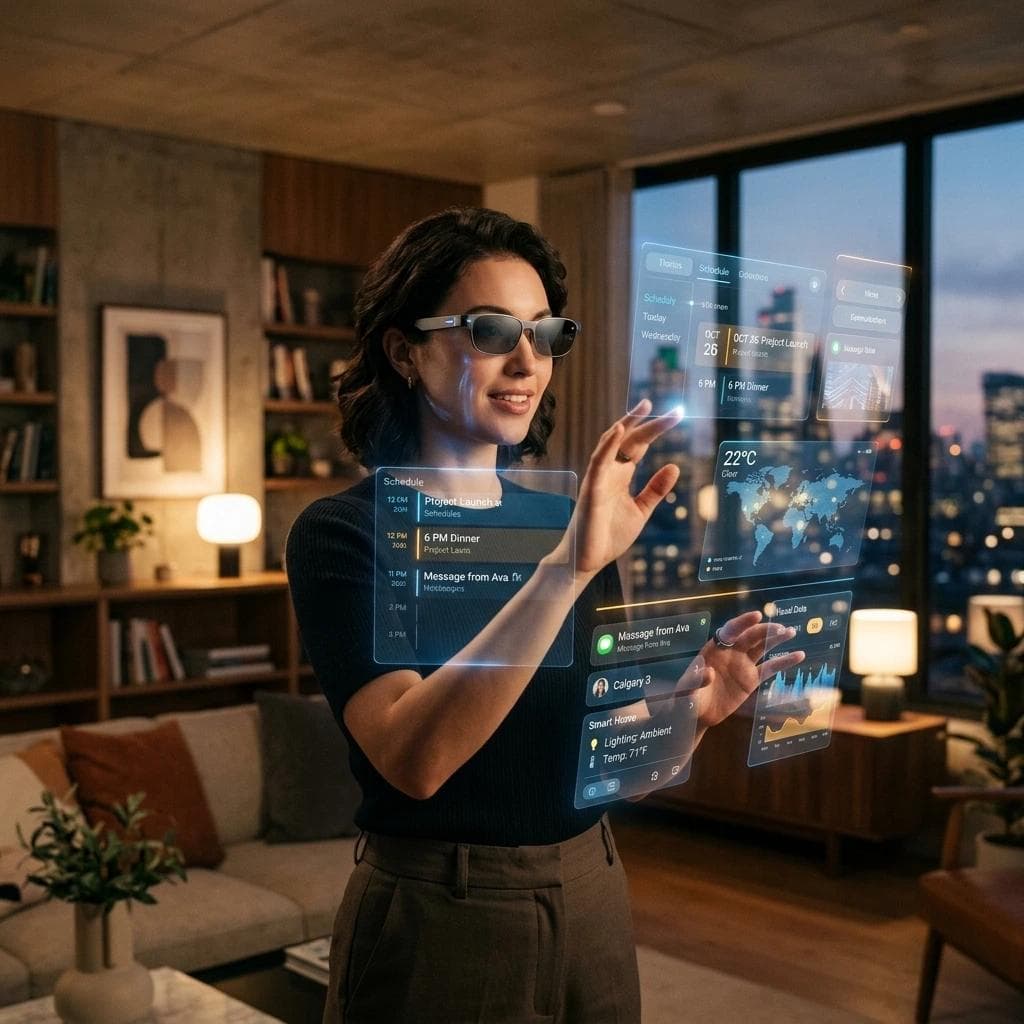
For the past fifteen years, the glowing rectangular screen has been the undisputed center of our digital universe. We wake up to it, work on it, and scroll ourselves to sleep with it. But in the boardrooms of Silicon Valley and global tech hubs, a tectonic shift is underway. Tech giants envision a future beyond smartphones, aggressively pivoting toward a new paradigm: ambient computing.
Industry leaders like Meta, Apple, Google, and Samsung are pouring billions into spatial computing, AI smart glasses, and wearable neural interfaces. Their shared goal? To make technology invisible, immersive, and seamlessly integrated into our environment.
If you want to understand where consumer tech is heading—and how it will impact your daily life and local business—you must look past the smartphone. Here is an in-depth analysis of the post-smartphone era.
The Tipping Point: Why the Smartphone Era is Peaking
Smartphones are not disappearing tomorrow, but their innovation curve has flattened. Today's upgrades are incremental—a slightly better camera, a marginally faster processor, or a slightly thinner bezel.
Consumer fatigue is setting in. According to recent market analysis from Counterpoint Research, global smartphone upgrade cycles have extended to nearly 40 months. Users are holding onto their devices longer because the leaps in capability are no longer revolutionary.
Tech giants recognize this saturation. To maintain their massive growth trajectories, they must create entirely new hardware categories that leverage the current explosion in Generative Artificial Intelligence. They are betting that the future is not something we hold in our hands, but something we wear, speak to, and live within. This pivot is complex, as executing an AI transformation is a problem of governance, not just a technology problem.
To learn more about how our experts analyze these market shifts, visit our About Us page.
The Post-Smartphone Paradigm: What Are Tech Giants Building?
The race to replace the smartphone is multifaceted. Rather than a single "one-device-fits-all" solution, tech giants are building an ecosystem of specialized hardware. Founders and investors navigating this space should consult our 2026 startup growth toolkit to understand how to scale within this new hardware paradigm.
1. Smart Glasses & AI Eyewear: The Eyes and Ears of AI
Smart glasses are currently experiencing a massive "scale-up" inflection point. Meta’s partnership with Ray-Ban proved that consumers want wearable AI—provided it looks stylish and feels natural.
These devices act as the "eyes and ears" of multimodal AI. Instead of pulling out a phone to search for information, you simply ask your glasses what you are looking at. Market analysts at Informa report that global AI smart glasses shipments hit 8.5 million units in 2025 and are projected to confidently exceed 10 million units in 2026. Meta currently dominates with an estimated 70–84% market share, but Apple is heavily rumored to be prepping its own sleek smart glasses for a 2027 launch. As we explore in our intelligent technology solutions blueprint, these devices are rapidly shifting from consumer toys to enterprise necessities.
2. Spatial Computing (AR/VR/MR): Merging Realities
When Apple launched the Vision Pro, they didn't call it a VR headset; they called it a "Spatial Computer." This distinction is critical. Spatial computing blends digital interfaces with the physical world.
While currently serving as high-end devices for productivity, 3D visualization, and remote assistance, spatial computers will eventually shrink down to the size of ordinary spectacles. The ultimate vision is a world where physical monitors are obsolete, replaced by infinite digital screens anchored in your physical room.
3. Wearable AI Devices: The Rise of Invisible Tech
Beyond eyewear, we are seeing the rise of screenless AI companions. Devices like smart rings (Oura, Samsung Galaxy Ring), AI pins, and advanced hearables monitor our health vitals, translate languages in real-time, and act as proactive digital assistants. These complex AI interactions require massive backend infrastructure, a phenomenon we detail in our analysis of the hidden costs of LLM deployment.
The Market Shift (2024–2028)
To understand the magnitude of this transition, we must look at the hard financial data. The shift from mobile to ambient computing represents a multi-billion dollar wealth transfer, heavily influencing venture capital trends (a topic we cover in our guide on bootstrapping vs. venture capital).
Below is a data table illustrating the projected growth of non-smartphone wearable and spatial tech markets globally. You can insert the following HTML block directly into your site to display the table:
| Technology Category | 2025 Market Size (Estimated) | 2026 Market Size (Projected) | Key Industry Players |
|---|---|---|---|
| AI Smart Glasses | $1.5 Billion - $3 Billion | $4.2 Billion+ | Meta, Snap, Google |
| Spatial Computing (Hardware/Software) | $55 Billion - $185 Billion | $75 Billion - $220 Billion | Apple, Meta, Microsoft |
| Broader Wearable AI (Rings, Audio, Pins) | $30 Billion - $44 Billion | $47 Billion - $56 Billion | Samsung, Oura, Humane |
Data aggregation sourced from Precedence Research, Grand View Research, and Fortune Business Insights (2025-2026 projections).
Looking for deeper insights on how to pivot your tech stack for these devices? Check out our latest blog updates for more enterprise strategies.
How Businesses Must Adapt to Screenless Search
If people aren't staring at smartphones, how will they find your local business?
Imagine a user walking down the streets of downtown Austin, Texas, or navigating the tech corridors of Seattle. Instead of typing "best coffee shop near me" into a phone, they will simply ask their AI glasses, "Which coffee shop on this block has the highest ratings and organic roasts?"
Preparing Your Strategy for Ambient Tech
To survive in a post-smartphone world, local businesses must optimize for multimodal and voice-driven AI:
- Hyper-Accurate Spatial Data: Your Google Business Profile and Apple Maps listings must be flawless. Spatial computers overlay digital data onto physical storefronts. If your geocoordinates are off by a few feet, the AI won't highlight your store.
- Conversational Long-Tail Keywords: Optimize your website content for how people speak, not just how they type. Focus on natural language queries.
- Real-Time Data Integration: In the near future, spatial computing will demand instant data accuracy, similar to the shift we are seeing in finance regarding the end of the monthly close and moving to real-time decision intelligence.
- Immersive Content: As AR becomes mainstream, businesses that offer 3D product previews or spatial walkthroughs of their venues will rank higher in spatial search engines.
Need help optimizing your local presence for the AI era? Reach out to our experts via our Contact Page.
The Core Technologies Driving the Shift
The vision of a post-smartphone world is only possible because several converging technologies have finally matured, driven by hardware visionaries—much like how NVIDIA's hardware paved the way for modern AI (read about Jensen Huang's early struggles). Here are the core pillars making ambient computing a reality:
- Multimodal Artificial Intelligence: Unlike early voice assistants (like basic Siri or Alexa), today's multimodal LLMs can process text, audio, and visual data simultaneously. Your glasses can "see" the foreign menu you are looking at and translate it audibly into your ear.
- Silicon Miniaturization: Companies like TSMC are printing chips at the 2-nanometer and 3-nanometer scale. This allows desktop-level processing power to be packed into lightweight eyeglass frames without overheating or draining batteries instantly.
- Next-Gen Connectivity (Wi-Fi 7 and 6G): To keep wearables lightweight, heavy computing is often offloaded to the cloud or a companion device in your pocket. This requires zero-latency connections.
- Brain-Computer Interfaces (BCIs): Companies like Neuralink and Synchron are pushing the absolute frontier. While currently focused on medical applications, the long-term vision is seamless, thought-driven interaction with digital environments—bypassing physical interfaces entirely.
The Trust Factor in Ambient Tech
In the smartphone era, we could put the device in a drawer. In the ambient computing era, the technology is always on, always listening, and always looking.
Navigating Privacy Concerns
For tech giants to successfully move consumers beyond the smartphone, they must solve the trust equation. The World Economic Forum highlights that data privacy is the primary bottleneck for wearable AI adoption.
Consumers must trust that the cameras on their smart glasses aren't secretly recording private moments, and that their biometric data isn't being exploited for hyper-targeted advertising. Brands that build transparent, hardware-level privacy controls will win the authoritative edge in this new market. We deeply understand the necessity of ethical tech deployment; read more about our philosophy in our Editorial Ethics and Privacy Policy.
Conclusion: Embracing the Invisible Revolution
Tech giants envision a future beyond smartphones because the limitations of a 6-inch glass screen have finally been reached. We are transitioning from a world where we use computers to a world where we interact with an intelligent, spatial environment.
Whether it is through a pair of Meta smart glasses guiding you through a foreign city, or an Apple spatial computer transforming your living room into a digital workspace, the next decade of technology will be defined by immersion. Businesses, marketers, and consumers alike must prepare for a future where technology is no longer something we carry, but something that seamlessly surrounds us.
References and Citations
- Counterpoint Research: Global Smartphone Market and Wearable AI Ecosystem Growth (2025-2026). Source
- Fortune Business Insights: Spatial Computing Market Size, Share & Industry Analysis (2025). Source
- Grand View Research: Wearable AI Market Analysis by Product (Smartwatch, Ear Wear, Eyewear) and Segment Forecasts. Source
- World Economic Forum: Ethics and Privacy in the Age of Ambient Computing. Source