
Securing startup capital is one of the most critical hurdles any founder will face. According to industry data from CB Insights, running out of cash and failing to raise new capital are among the top reasons startups fail. For pre-revenue founders and early-stage entrepreneurs in 2026, the age-old debate remains: Should you bootstrap your startup or seek venture capital (VC)?
Both bootstrapping (self-funding) and venture capital offer distinct advantages and significant drawbacks. The "correct" choice depends entirely on your business model, growth trajectory, and long-term vision as an entrepreneur. In this comprehensive guide, we will break down both funding paths, providing data-backed insights to help you make an informed decision for your venture.
What is Bootstrapping?
Bootstrapping a startup means growing your business with little to no outside cash. Instead of pitching investors, bootstrapped founders rely on personal savings, sweat equity, lean operations, and, most importantly, revenue from early customers to fund ongoing growth.
Companies like Mailchimp, GitHub (in its early days), and Spanx famously began as bootstrapped ventures, proving that you do not necessarily need a multi-million-dollar seed round to achieve unicorn status.
The Advantages of Bootstrapping
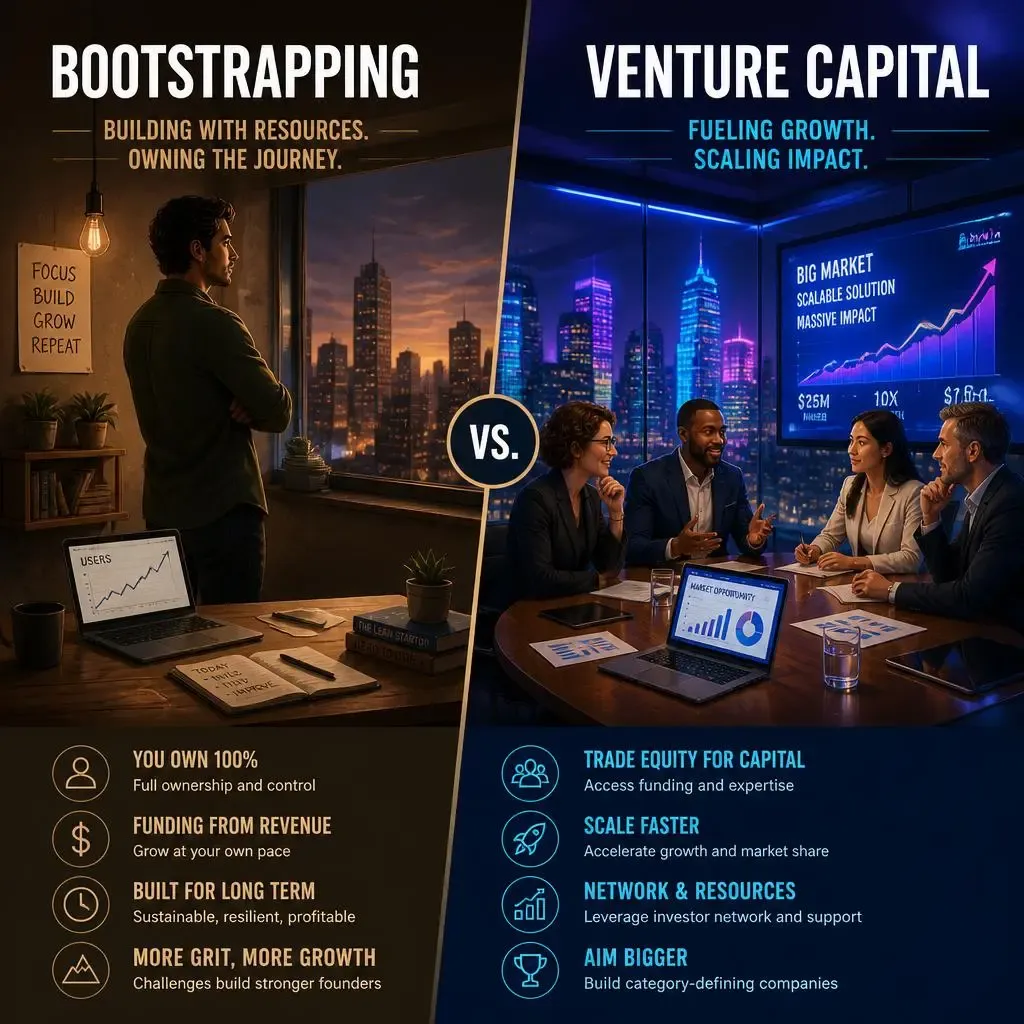
- 100% Ownership and Control: The most significant benefit of bootstrapping is that you retain full equity and creative control over your company. You answer to your customers, not to a board of investors.
- Forced Financial Discipline: When you are spending your own money, you tend to spend it wisely. Bootstrapping forces founders to focus on profitability and sustainable business models from day one.
- Agility and Pivot-Readiness: Without investors dictating the roadmap, bootstrapped startups can pivot quickly based on market feedback. Furthermore, focusing on lean, intelligent technology solutions allows founders to automate heavy workloads without massive payrolls.
The Disadvantages of Bootstrapping
- Slower Growth Rate: Without a massive influx of capital, scaling operations, hiring top talent, and expanding marketing efforts take much longer.
- Personal Financial Risk: Founders often have to drain their personal savings or take on personal debt, putting their own financial security on the line.
- Limited Network and Resources: Building professional credibility takes time. While you can look for cost-effective chamber of commerce alternatives, VCs naturally bring pre-built connections, mentorship, and industry expertise that bootstrapped founders must build from scratch.
Pro-Tip for Bootstrappers: If you are bootstrapping, focus intensely on finding a niche audience willing to pay for your minimum viable product (MVP) immediately. Cash flow is your lifeblood.
What is Venture Capital?
Venture Capital (VC) involves raising external funds from investment firms in exchange for equity (ownership) in your company. VCs specifically look for startups with high growth potential, disruptive technology, and massive total addressable markets (TAM).
In exchange for their financial investment, VCs typically take a percentage of your company and often require a seat on your board of directors.
The Advantages of Venture Capital
- Rapid Scaling (Hypergrowth): VC funding provides the fuel needed to hire aggressive sales teams, launch massive marketing campaigns, and rapidly capture market share before competitors catch up. It also allows you to invest heavily in top-tier instructional technology services to quickly onboard and train a growing workforce.
- Industry Validation and Prestige: Securing funding from a reputable VC firm acts as a stamp of approval, making it easier to attract top-tier talent, secure press coverage, and land enterprise clients.
- Strategic Mentorship: Good VC partners provide invaluable guidance, leveraging their experience of scaling dozens of other successful companies (often backed by research from institutions like Harvard Business School).
The Disadvantages of Venture Capital
- Dilution of Ownership: By taking VC money, you are selling a piece of your company. Over multiple funding rounds, founders can easily lose majority ownership.
- The "Grow at All Costs" Pressure: VC firms operate on a model that requires massive returns. They will push you to grow exponentially, which can lead to burnout, poor company culture, or premature scaling.
- Loss of Control: Once you accept VC money, you have a fiduciary duty to your investors. You may be forced out of your own company if the board believes you are no longer the right CEO.
Caution: Only a tiny fraction of startups successfully secure venture capital. Do not build a business model that requires VC funding to survive unless you are confident in your ability to pitch and close.
Bootstrapping vs. Venture Capital: A Side-by-Side Comparison
To make the decision easier, here is a breakdown of how these two funding paths compare across key startup metrics:
| Metric | Bootstrapping | Venture Capital |
|---|---|---|
| Control & Equity | Founder retains 100% control and ownership. | Shared control; significant equity given to investors. |
| Growth Speed | Organic, slower, directly tied to real revenue. | Accelerated, hyper-growth focused. |
| Risk Profile | High personal financial risk for the founder. | Low personal risk; high professional pressure to perform. |
| Business Focus | Immediate profitability and positive cash flow. | User acquisition, market capture, and scaling. |
| Exit Strategy | Optional. Can operate as a profitable lifestyle business indefinitely. | Mandatory. VCs expect an eventual IPO or acquisition. |
How to Choose the Right Funding Path for Your Startup
There is no universally correct answer. The best path depends on the DNA of your startup.
Choose Bootstrapping if:
- You are building a service-based business, an agency, or a highly specialized niche product.
- You want to build a profitable "lifestyle business" that generates steady, reliable income.
- You are highly averse to giving up control or taking orders from a board.
- Your business can generate revenue almost immediately upon launch.
Choose Venture Capital if:
- You are building capital-intensive software, hardware, or deep tech.
- Your market is a "winner-takes-all" environment where speed to scale is the only defense.
- You are aiming to build a billion-dollar company (a unicorn) and are comfortable with the high risk of failure that comes with swinging for the fences.
- You want an eventual exit strategy (IPO or acquisition).
Conclusion: Blending the Two Approaches
It is worth noting that these two paths are not mutually exclusive. A growing trend in 2026 is "Bootstrapping to Series A."
Founders will bootstrap the initial build, achieve product-market fit, and generate early revenue. Once the business is proven and de-risked, they then approach venture capitalists. By delaying VC funding, founders retain more equity and have significantly more leverage at the negotiating table. TechCrunch often highlights founders who have successfully leveraged this hybrid model.
Whether you choose the slow, steady, and profitable path of bootstrapping, or the rocket-ship trajectory of venture capital, ensure your decision aligns with your personal risk tolerance and your ultimate vision for your business. To learn more about our mission and how we support founders on this journey, visit the Sovereix About Us page.
Frequently Asked Questions (FAQ)
1. Can I switch from VC funding to bootstrapping later? No. Once you take venture capital and sell equity, you are on the VC track. You cannot easily "buy back" your company or switch to a slow-growth lifestyle business model, as your investors require a significant return on their capital.
2. Is angel investing the same as venture capital? Similar, but not identical. Angel investors are typically wealthy individuals investing their own money in very early-stage startups, whereas Venture Capital firms invest institutional money (from pension funds, endowments, etc.) at larger scales. Angels often offer better terms for early-stage founders compared to traditional VCs.
3. What are alternative funding options? If neither bootstrapping nor VC fits, look into small business loans, crowdfunding (like Kickstarter or equity crowdfunding platforms), or non-dilutive government grants. If you are a young founder, explore resources dedicated to youth entrepreneurship support.