

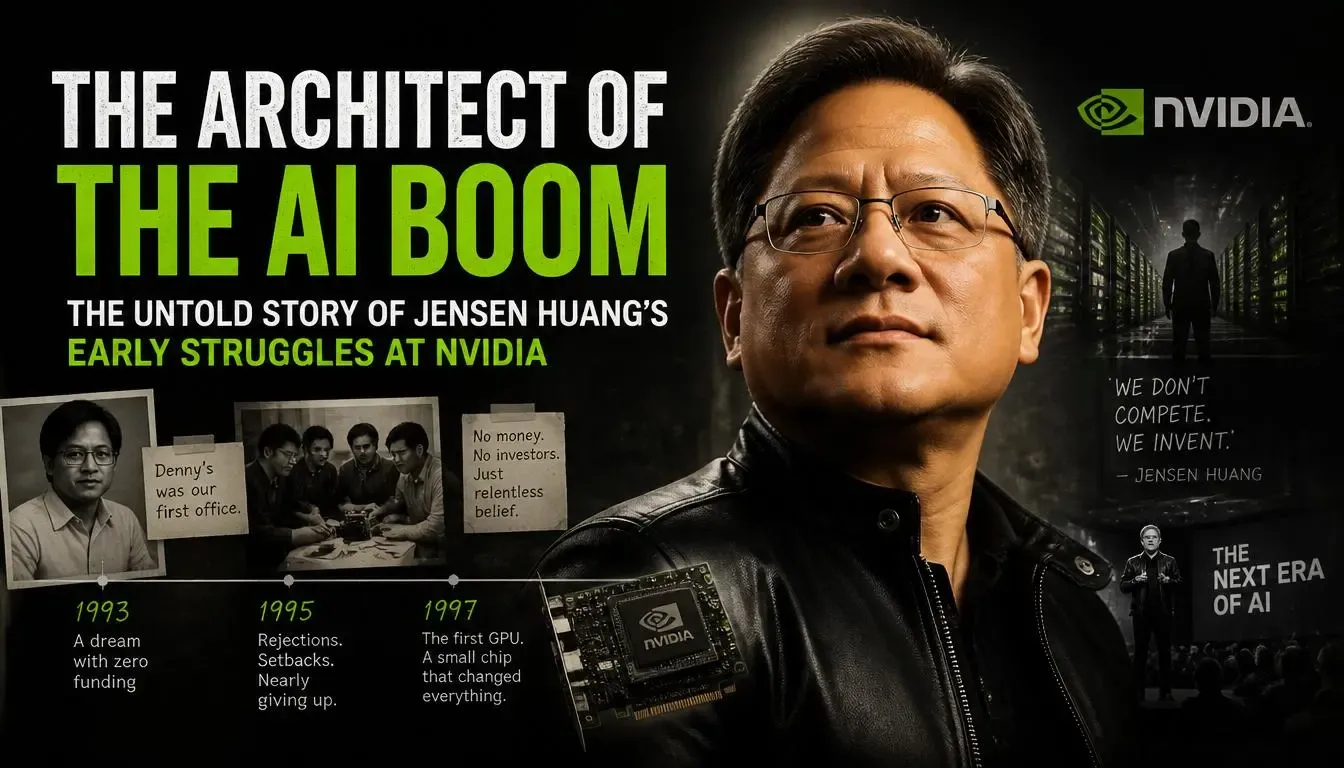
When we look at Nvidia today—a multi-trillion-dollar titan powering the global artificial intelligence boom, the metaverse, and next-generation gaming—it is almost impossible to imagine the company on the absolute brink of total collapse.
Jensen Huang, the iconic, leather-jacket-wearing CEO, is universally celebrated as a generational visionary. He is the architect of the AI hardware revolution. Yet, the true measure of his leadership wasn't forged in the pristine server farms of the modern AI era. Instead, it was tempered in a series of near-fatal missteps, sleepless nights, and massive layoffs during the mid-1990s.
This is the untold story of Nvidia's chaotic early days, the catastrophic failure of their very first products, and the astonishing, intellectually honest gamble that ultimately saved the company from bankruptcy.
At Sovereix, we believe that studying the darkest days of today's tech giants offers the most profound, actionable lessons for modern entrepreneurship. Let’s dive deep into the crucible that forged Nvidia.
The Humble Beginnings: A Multi-Billion Dollar Vision Born in Denny’s
The origin story of Nvidia lacks the glamour of a sleek corporate boardroom. In 1993, Jensen Huang, alongside co-founders Chris Malachowsky and Curtis Priem, conceptualized the company in a booth at a Denny’s restaurant in East San Jose, California.
For Huang, this setting was deeply poetic. Years prior, as a 15-year-old immigrant, his first job was working at a Denny’s as a dishwasher and server—an experience he often credits with teaching him a strong work ethic and the ability to handle high-stress situations.
Fueled by endless cups of diner coffee, the trio recognized a massive, untapped opportunity. They believed that the PC, which was primarily a tool for typing and basic spreadsheets, would eventually become a powerful hub for consumer gaming and multimedia. They envisioned specialized microprocessors capable of rendering complex 3D graphics, a concept that was highly theoretical at the time.
With $40,000 in the bank, Nvidia was born. However, the path from a Denny's booth to the dominant force in Silicon Valley was fraught with existential threats, much like the funding dilemmas discussed in our analysis of bootstrapping vs venture capital.
The First Major Stumble: The NV1 and the Quadratic Trap
Nvidia’s first major product release, the NV1 multimedia accelerator, hit the market in 1995. At the time, the standards for 3D graphics were entirely unsettled.
Nvidia placed a massive technical bet on an architecture known as "Quadratic Texture Mapping" (quads). They believed this mathematical approach would deliver superior curves and smoother visuals compared to other rendering methods.
Unfortunately, this bet proved disastrous. Shortly after the NV1's development, Microsoft introduced Windows 95 along with a new graphics API called DirectX. Microsoft’s standard relied entirely on rendering polygons (specifically, triangles), not quadratic surfaces.
Virtually overnight, the entire software and game development industry adopted the triangle-based DirectX standard. The NV1, despite its engineering ingenuity, was mathematically incompatible with the direction the entire industry was moving.
Sales stagnated. Nvidia found itself holding a technologically obsolete product, isolated from the market. The financial consequences were immediate and brutal. Cash reserves dried up, forcing Huang to make agonizing decisions. Nvidia slashed its headcount drastically, dropping from over 100 employees down to a skeleton crew of roughly 30.
If you are a startup founder navigating sudden market shifts, you understand this panic. Often, these moments require a structural shift in leadership, much like moving beyond early growth hacks to a value-added strategy.
The Sega Contract: A Lifeline or a Death Sentence?
Amidst the NV1 fallout, Nvidia had one major lifeline keeping the lights on: a development contract with Japanese gaming giant Sega.
Sega had hired Nvidia to develop the graphics processor (codenamed NV2) for their upcoming video game console. Because Sega was funding the development, this contract was the only thing preventing Nvidia from completely running out of money.
However, there was a fatal flaw. The NV2 was being built on the same doomed quadratic architecture as the NV1. As development progressed, Huang and his engineering team came to a terrifying realization: they were building the wrong product. Even if they finished the chip perfectly to Sega's specifications, it would be technologically inferior and incompatible with the broader gaming ecosystem that had embraced triangle polygons.
Continuing the project meant guaranteed long-term failure, but stopping the project meant breaching the contract, losing Sega's funding, and facing immediate bankruptcy. It was the ultimate "sunk cost" fallacy trap, requiring a collaborative capital mindset to resolve.
The Defining Moment: Intellectual Honesty and a Plea for Survival
What Jensen Huang did next defines his legacy and serves as a masterclass in executive leadership. Rather than hiding the truth or delivering a doomed product, Huang flew to Japan to meet directly with Sega’s executive leadership, including then-CEO Shoichiro Irimajiri.
In an act of supreme vulnerability and intellectual honesty, Huang admitted the truth. He explained that Nvidia's architecture was the wrong path for Sega's console. He advised Sega to find a new partner and abandon the NV2 project.
But Huang didn't stop there. He looked across the table and made an audacious request. He explained that if Sega stopped the funding, Nvidia would immediately go bankrupt. He asked Sega to pay Nvidia the remaining contract money anyway, despite the project's failure, so that Nvidia could survive long enough to build a new chip using the correct architecture.
In a move of astonishing grace and corporate foresight, Sega agreed. They recognized Huang's honesty, allowed Nvidia to keep the funding, and essentially gave the company a second chance at life. (Sega later sold their resulting Nvidia stock in 1999 during the IPO; had they held it today, it would be worth hundreds of billions of dollars. If you're curious about how companies are valued today, try our business valuation tool).
The Turning Point of Nvidia
To understand the magnitude of this shift, we must look at the data and the structural pivot Nvidia executed. Below is a breakdown of how the company transitioned from the brink of death to market dominance.
| Strategic Metric | The NV1 Era (1995) | The RIVA 128 Era (1997) |
|---|---|---|
| Rendering Architecture | Quadratic Texture Mapping (Quads) | Polygon/Triangle Mapping |
| Market Alignment | Proprietary / Isolated | 100% Microsoft DirectX / Direct3D Compliant |
| Financial State | Near Bankruptcy (Headcount reduced to ~30) | Massive Revenue Influx, Saved the Company |
| Strategic Focus | Stubborn adherence to original hypothesis | Agile adaptation to industry standards |
The Bet-the-Company Pivot: The RIVA 128
With only six months of runway left from the Sega funds, Nvidia initiated a "bet-the-company" pivot. They abandoned everything they had built and started from scratch, fully embracing the triangle-based DirectX standard.
Because they had no margin for error, Huang made another incredibly risky decision. He spent a significant portion of their remaining cash on a highly expensive, unproven hardware emulator (from a company called IKOS). This allowed the engineering team to test the chip design meticulously before committing to the expensive "tape-out" (manufacturing) process. They couldn't afford a second physical prototype; the first one had to be perfect.
In 1997, Nvidia released the RIVA 128. It was a massive commercial success. By focusing entirely on standard compatibility and raw performance, the RIVA 128 captured significant market share, saving the company and laying the foundational architecture for what would eventually become the modern GPU (Graphics Processing Unit).
Today, managing the costs of technology is just as critical, as seen in the hidden costs of LLM deployment.
5 Core Leadership Lessons from Jensen Huang’s Early Struggles
Nvidia's culture today—one of hyper-resilience and rapid innovation—is a direct byproduct of these early failures. Here are the top five lessons modern leaders can extract from Huang's journey:
- Embrace "Evolution Through Failure": Failure is only fatal if you refuse to learn from it. Nvidia’s failure with the NV1 taught them how to be agile, a trait that allowed them to pivot to AI decades later. This kind of flexibility is essential for scaling without losing control.
- Intellectual Honesty is Non-Negotiable: Confronting reality is hard. Admitting you are on the wrong path, especially to investors or clients, requires immense courage. Huang’s honesty with Sega saved Nvidia.
- Align with the Industry (or Build the Standard): Don't fight the tide of standardization. Unless you have the capital to force a market shift (like Apple), building products that seamlessly integrate into existing ecosystems (like DirectX) is crucial for early survival.
- Take Calculated "Bet-the-Company" Risks: When your back is against the wall, incremental changes won't save you. The purchase of the IKOS hardware emulator was a massive financial risk, but it was a calculated necessity to ensure the RIVA 128 worked flawlessly.
- Value Strategic Relationships Over Short-Term Wins: By prioritizing transparency with Sega over a short-term cash grab, Huang preserved his reputation and secured the ultimate lifeline.
What This Means for Local Tech Innovators in Silicon Valley
For startups operating in competitive tech hubs like Silicon Valley, Austin, or London, the Nvidia story is a testament to the power of local ecosystems. Nvidia was saved not just by code, but by the physical proximity and relationships fostered in the San Jose and broader international tech community.
Local SEO and digital footprint matter, but face-to-face integrity—like flying out to meet a partner in person—remains undefeated. Today, local startups must balance cutting-edge digital growth strategies with fundamental, human-centric business practices. We often see that true AI transformation is a problem of governance, not just technology.
If your local tech company is facing its own pivot, or if you need strategic guidance on scaling your digital presence to match your innovative hardware or software, Contact Sovereix today. Our expert consultants have the real-world experience to guide you through the turbulent waters of tech entrepreneurship.
References & Citations:
- Historical data regarding the NV1, RIVA 128, and Sega partnership sourced from Nvidia's corporate historical archives and Jensen Huang's public commencement addresses (e.g., National Taiwan University, 2023).
- Details regarding DirectX market share and 3D graphics history cross-referenced with mid-1990s technology industry reports.