

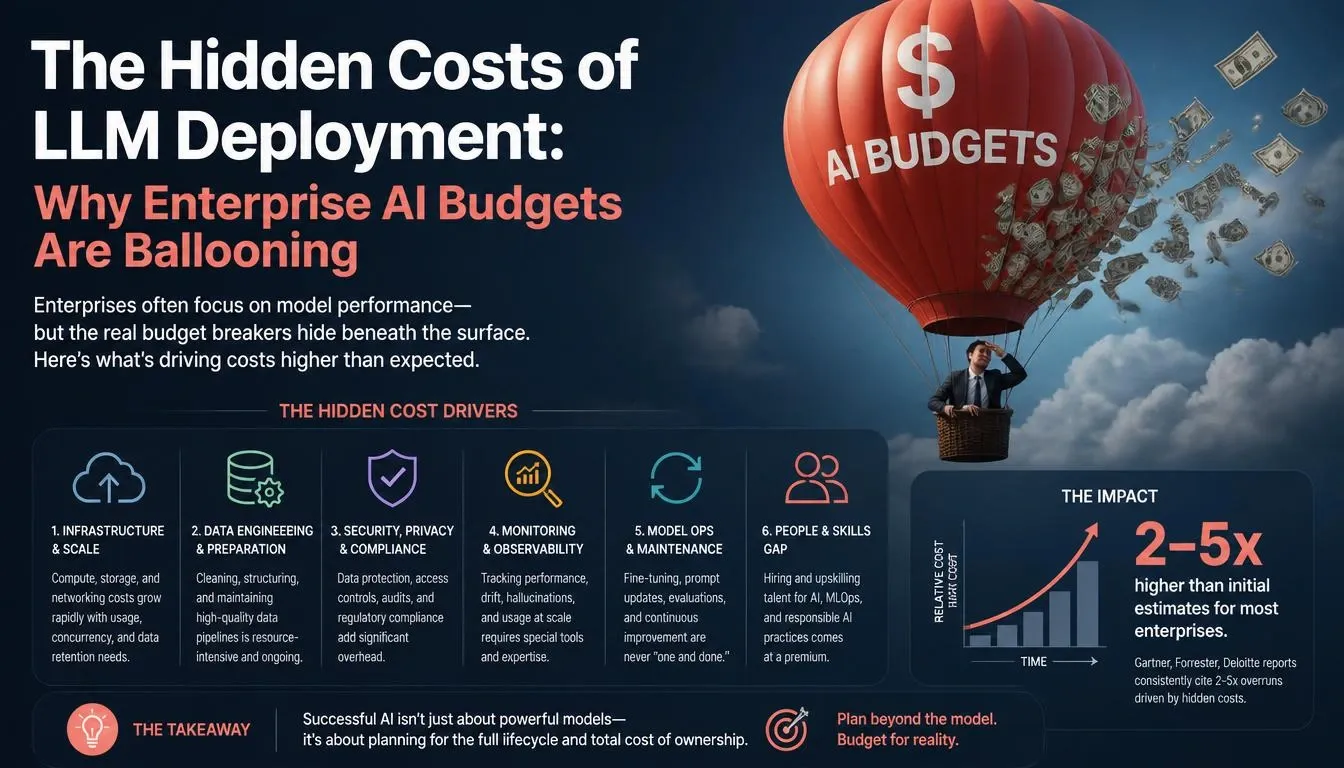
Across boardrooms from Silicon Valley to Wall Street, and spanning global financial hubs like London and Singapore, a quiet panic is setting in among Chief Financial Officers. Over the past few years, enterprises have aggressively adopted artificial intelligence. They ran successful pilots, wowed stakeholders with generative AI chatbots from OpenAI and Anthropic, and approved massive IT budgets to scale these tools.
But as we push deeper into 2026, the transition from experimental pilots to full-scale production has revealed a harsh economic reality: the true cost of deploying Large Language Models (LLMs) is wildly exceeding initial projections.
In fact, recent industry data reveals that a staggering 92% of organizations deploying agentic AI report costs exceeding their initial expectations. If you are an enterprise leader or a sovereign investor allocating capital toward AI infrastructure, understanding unit economics is no longer optional.
In this comprehensive analysis, we will unpack the hidden costs of LLM deployment, why enterprise AI budgets are ballooning, and how the smartest organizations are implementing "AI FinOps" to regain control.
For more insights on our overarching philosophy on sustainable enterprise technology and wealth strategies, visit our About Us page.
The "Pilot to Production" Reality Check
When organizations first test an LLM, they usually look at a very simple metric: the cost per 1,000 tokens charged by cloud providers like Microsoft Azure AI or Google Cloud Vertex AI. Because these baseline API costs have actually dropped over the last two years due to compute commoditization, many executives assumed that scaling AI would be cheap.
This assumption was fundamentally flawed.
The cost of an API call is merely the tip of the iceberg. As enterprises move LLMs out of isolated sandbox environments and integrate them into customer-facing applications and legacy backend systems, the operational overhead multiplies exponentially.
Real Data: The 2026 AI Spend Explosion
According to 2026 analytics on enterprise cloud infrastructure, the median monthly LLM spend among large enterprises grew 7.2x year-over-year from 2025.
Furthermore, while 80% of enterprise applications shipped in the first quarter of 2026 embedded at least one AI agent, only 31% of organizations actually have an autonomous agent running safely in production. The primary bottleneck? They simply cannot figure out how to govern the runaway costs.
(If you are struggling with the structural integration of AI, we highly recommend reading our deep dive: Why AI Transformation is a Problem of Governance, Not Technology).
Unmasking the Hidden Costs of Large Language Models
To stop the bleeding, enterprise leaders must identify exactly where the money is going. The "hidden" costs of LLM deployment generally fall into three distinct categories.
1. The Agentic Multiplier Effect
In 2023, we built basic chatbots. In 2026, we are building autonomous AI agents capable of reasoning and executing complex tasks. However, agentic AI is fundamentally more expensive.
When a user asks a simple chatbot a question, it generates one API call. But when an AI agent receives a complex prompt, it must reason, retrieve external context from a vector database like Pinecone or Milvus, verify internal security policies, draft a response, self-correct, and then execute the action. A single customer interaction can easily trigger 4 to 8 distinct API calls to frontier models. This non-linear scaling is known as the "Agentic Multiplier," and it is devastating unmonitored IT budgets.
2. The Human Capital Deficit (MLOps and Security)
Hardware and compute are expensive, but human talent is still the largest line item in any enterprise AI budget. For organizations attempting to self-host open-source models (such as Meta's Llama 3) for data privacy reasons, the cost of specialized talent is astronomical.
Hiring Machine Learning Operations (MLOps) engineers, AI security specialists, and data pipeline architects can cost 2x to 3x more than the underlying hardware over a three-year horizon. AI requires constant tuning to prevent model drift and hallucination. It is not a "set it and forget it" technology.
3. Technical Debt and Data Pipeline Maintenance
An LLM is only as good as the data it is fed. Maintaining high-quality Retrieval-Augmented Generation (RAG) pipelines requires massive data engineering efforts. Vector databases must be constantly updated, indexed, and scrubbed for Personally Identifiable Information (PII) to comply with frameworks like the GDPR and the California Consumer Privacy Act (CCPA). Over time, the technical debt required to keep legacy data systems integrated with cutting-edge AI models becomes a massive financial sinkhole.
Visualizing the Enterprise AI Budget Breakdown
To illustrate how these costs stack up, we have visualized the typical enterprise AI budget allocation in 2026 for a production-grade deployment. Notice how API token costs are dwarfed by operational overhead.
5 Strategies to Reign in Runaway LLM Costs
Despite these challenges, AI remains the most powerful deflationary technology of our generation. However, realizing those savings requires strict financial discipline. Forward-thinking Chief Information Officers (CIOs) are adopting a practice known as AI FinOps to regain control over their margins.
Here are five proven strategies to optimize your LLM deployment costs in 2026:
1. Adopt Model Routing and Tiering
It is financial malpractice to use a massive "frontier" model to answer simple, routine user queries. Smart enterprises use "model routers." A lightweight routing algorithm determines the complexity of a prompt. Simple tasks (like text formatting or basic data retrieval) are routed to cheap, fast models, while complex reasoning tasks are routed to expensive frontier models. This single change can reduce monthly inference spend by up to 70% to 80%.
2. Transition to Small Language Models (SLMs)
Bigger is not always better. A major trend this year is the pivot toward Small Language Models (SLMs) with under 10 billion parameters. When fine-tuned on highly specific corporate data using techniques from platforms like Hugging Face, an SLM can outperform a massive frontier model on niche tasks at a fraction of the compute cost. We see this heavily in specialized industries; for example, dental practices are using localized voice AI rather than generalized cloud models (read our breakdown on Bola AI and Voice Tech).
3. Establish Hard API Guardrails
Without granular observability, a single software bug can bankrupt an IT budget. In one high-profile incident, a corporate user incurred a massive compute bill in a single weekend because an autonomous agent got stuck in an infinite "reasoning loop." Enterprises must use monitoring tools like Datadog LLM Observability to implement strict per-tenant token quotas, automatic kill-switches, and rate limiting at the API gateway layer.
4. Utilize Hybrid On-Premise Deployments
To stabilize predictable, high-volume workloads and satisfy strict data sovereignty laws in regions like the EU and localized sectors in the US, enterprises are moving away from purely cloud-based AI. By partnering with hardware giants like NVIDIA for on-premise compute clusters, companies cap their maximum monthly spend rather than leaving API tabs open indefinitely.
5. Implement Semantic Caching
If your users frequently ask the same questions (e.g., "What is the HR holiday policy?"), your application should not be generating a brand-new response from the LLM every time. Semantic caching stores the embeddings of previous answers. If a new prompt is mathematically similar to a cached prompt, the system instantly returns the cached answer, costing zero API tokens.
Conclusion and Next Steps
The era of unrestricted AI experimentation is officially over. As we navigate 2026, the winners in the enterprise space will not necessarily be the companies with the smartest foundation models, but rather the companies with the most efficient AI unit economics.
For the sovereign investor, this shift presents a massive opportunity. Venture capital is flowing away from generalized models and pouring into startups building AI FinOps tools, semantic routers, and specialized Small Language Models that actually generate positive cash flow.
Understanding the hidden costs of LLM deployment is the first step in ensuring your digital transformation yields actual financial returns, rather than just ballooning IT budgets.
Are you an investor or enterprise leader grappling with AI deployment costs? We want to hear your strategy. Reach out to our analysts via our Contact page, or explore more exclusive research for the serious investor at Sovereix.com.