

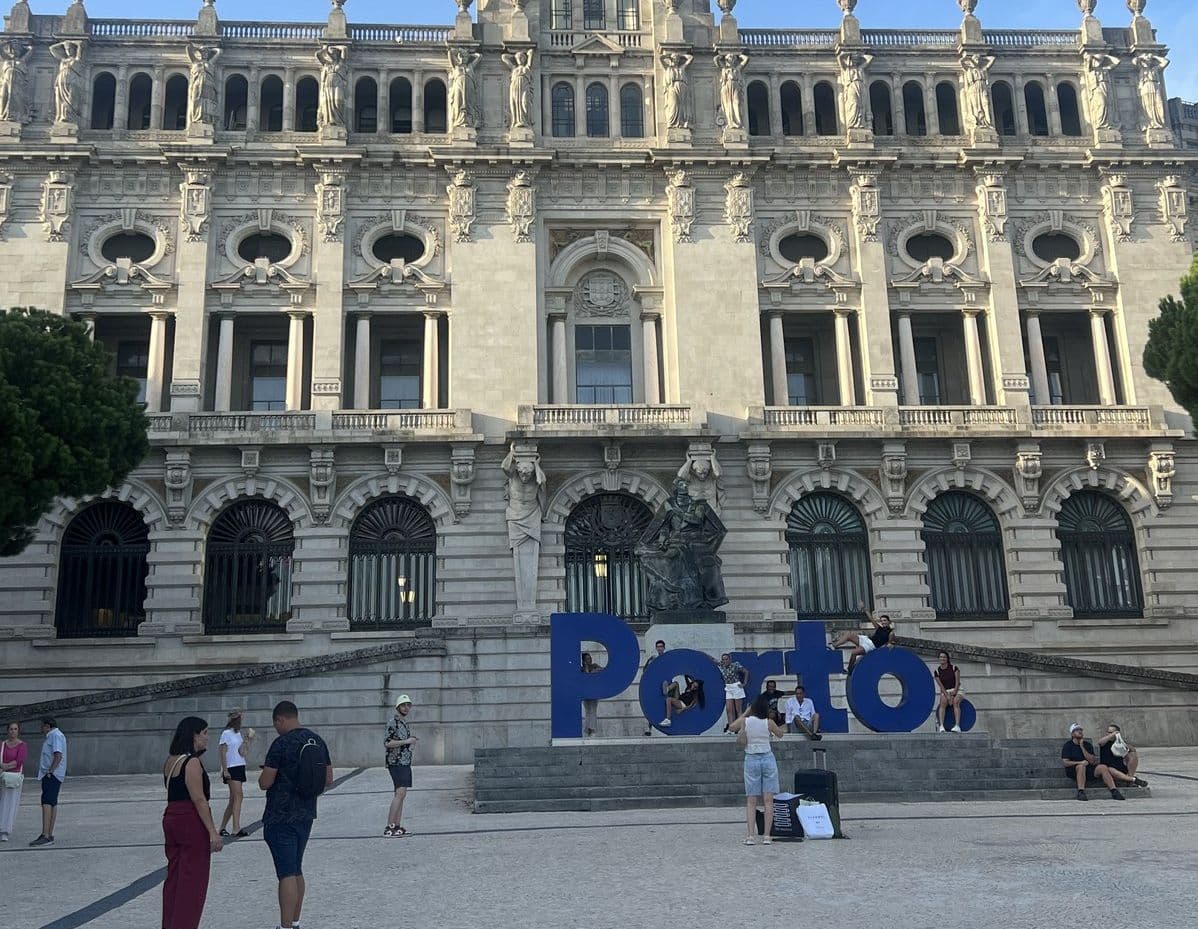
At the center of Avenida dos Aliados, in front of the massive stone walls that make up the facade of Porto's City Hall, there is a small, bright blue, minimalist installation called "Porto." Visitors find it hard to resist taking pictures next to this installation. Venture capitalists, urban planners and city economists view it as one of the best examples of how to re-brand a city in the 21st century.
The Anatomy of an Open Civic Identity
In 2014, when the city was still experiencing some economic drag from its post-austerity period and a lack of a cohesive civic presence, the Porto City Council turned to the local design studio White Studio to help find solutions to a very fundamental problem for the city: how can you represent the essence of such an old, multi-faceted metropolitan area without creating stereotypical tourist-type representations?
The answer was radical because of how simple it was. Instead of using a fixed promotional logo, the city created an adaptable visual system that used the word "Porto.", with a bold period after it; and a large modular library of blue and white geometric icons representing the city's architecture, tramways, maritime history, and Douro wine culture.
Crucially, City Hall didn't keep the copyright to themselves. Instead, they viewed the brand as part of the public infrastructure so that all of the city's businesses, technology conferences, public transportation systems, and growing companies could use and incorporate the city's visual identity throughout its urban environment.
Powering the FDI and Startup Flywheel
While a single brand provided Porto with instant recognition worldwide, the city didn't just focus on how it looked. The City Council used its brand as the first step in a strategic plan to help boost the local economy.
- The City of Porto has developed a series of programs such as ScaleUp Porto to help connect local engineering students at the University of Porto (FEUP) to global venture capital.
- Foreign Direct Investment – created a strong brand image that identified Porto as an innovative, forward-looking European center. This attracted many of the world's leading technology companies to establish their development centres in Porto and allowed for local startups such as Sword Health, Feedzai, and Farfetch to grow into "unicorns".
- The Talent & Capital Migration: The growing operational challenges experienced by founders in London, Berlin, and San Francisco have created opportunities for other cities to attract these founders. Porto’s strong cultural heritage, along with its tax incentives, has helped position Porto as an attractive option for remote executives and international capital.
Lessons for Emerging Tech Hubs
Porto's path forward is a viable model for small to medium-sized cities that must compete with other cities for capital investment.
- Brand as Infrastructure, Not Marketing: The failure of civic branding occurs when it is seen as a quick-fix marketing effort. Porto was successful in part due to the fact that its visual system was used as the operational foundation for transit systems, public utilities, and promotional activities.
- Secure Aesthetics through Implementation: Aesthetic appeal can draw the eye, but regulatory certainty, centers of technology, and employee retention seal the deal.
- Ride High On Authenticity, Not Imitation: Instead of positioning itself as "the next Silicon Valley," Porto reinforced its unique architectural tradition and Atlantic identity.
In an economy characterised by liquidity without borders and distributed talent, a city's brand is not merely ornamental overhead; it is economic infrastructure.