
When you walk into a traditional bank to request a business loan, the first thing the loan officer asks for isn't your business plan or your grand vision—it's your credit history. For millions of entrepreneurs across the globe, particularly in emerging markets, this single request is a closed door. Without a formal credit file, also known as a "thin file," accessing the capital necessary to grow a business becomes nearly impossible.
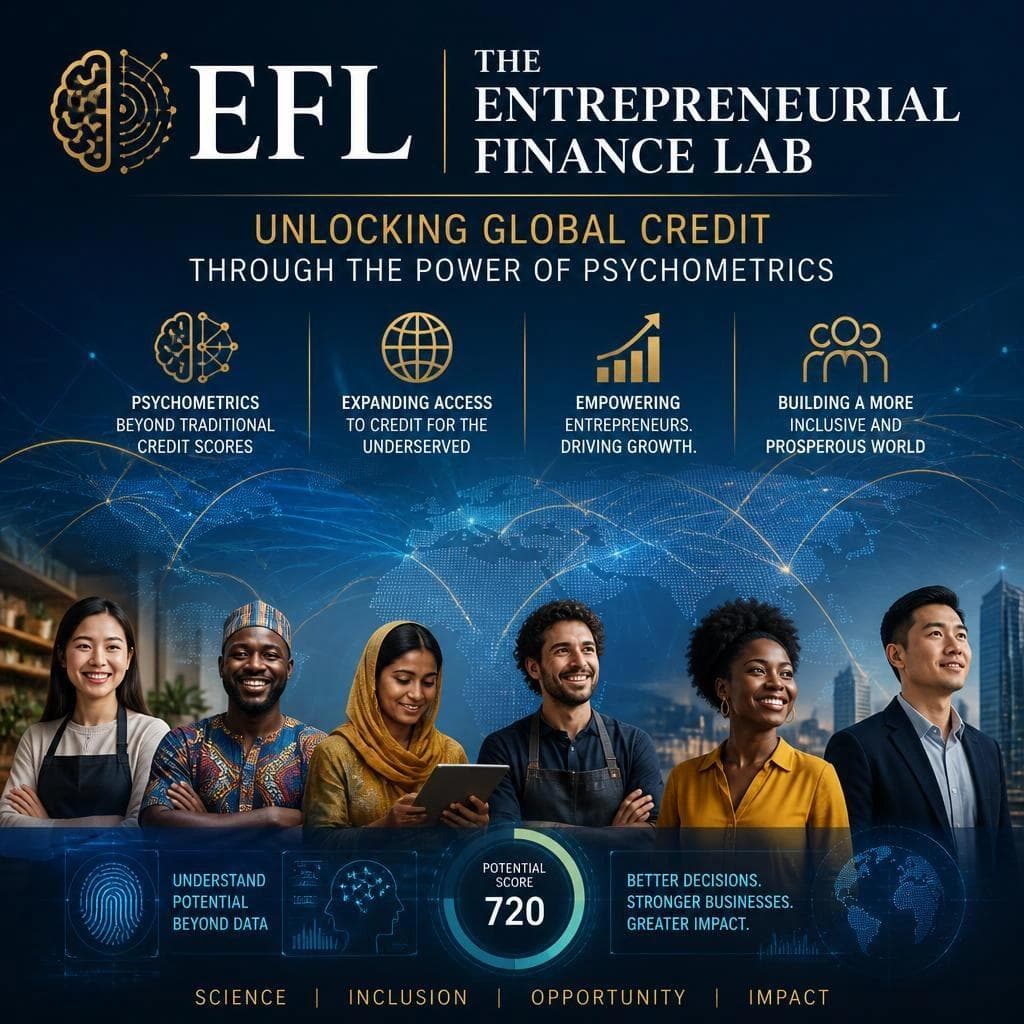
This systemic global financial bottleneck led to the creation of the Entrepreneurial Finance Lab (EFL). Originating as a research initiative at Harvard University, EFL pioneered a revolutionary approach to lending: using psychometric testing to assess creditworthiness.
In this comprehensive guide, we will explore the origins of the Entrepreneurial Finance Lab, dive deep into the science of psychometric credit scoring, analyze real-world impact data, and understand how alternative data is reshaping the financial landscape for small and medium-sized enterprises (SMEs) globally.
For more insights on innovative financial strategies, explore our comprehensive guide to Alternative Data in Finance.
What is the Entrepreneurial Finance Lab?
The Entrepreneurial Finance Lab was born out of the Harvard Kennedy School and the Harvard Business School. Researchers recognized a glaring inefficiency in global financial markets: traditional credit scoring models—like the FICO score in the United States—rely heavily on past financial behavior.
But what happens when a borrower operates in a cash-based economy? What if they have never taken out a formal loan? Traditional banks label these individuals as "unscorable" and, by extension, high-risk. This creates a massive credit gap, estimated by the World Bank to be in the trillions of dollars for SMEs in developing nations.
EFL was founded to bridge this gap. Instead of looking backward at financial history, EFL's founders asked a forward-looking question: Can we predict a person's willingness and ability to repay a loan based on their personality and cognitive traits?
The Shift from Financial History to Human Potential
The core philosophy of EFL is that an entrepreneur's character is a measurable and reliable indicator of future financial behavior. By utilizing advanced behavioral science, EFL developed a digitized psychometric assessment that could be administered via a tablet, smartphone, or computer in under 45 minutes.
This assessment doesn't ask about income or collateral. Instead, it measures traits like business acumen, fluid intelligence, honesty, and risk tolerance. For a "thin-file" borrower, this test replaces the traditional credit report, providing financial institutions with a quantitative risk score.
The Science Behind Psychometric Credit Scoring
Psychometric scoring might sound like science fiction to traditional underwriters, but it is grounded in decades of psychological research. The EFL assessment evaluates multiple dimensions of an applicant's psychological profile to generate a holistic credit score.
Key Personality Traits Assessed
To understand how EFL works, we need to look at the specific psychological domains their tests measure:
- Fluid Intelligence: The ability to solve novel problems and adapt to new situations. Entrepreneurs with high fluid intelligence are better equipped to navigate market volatility.
- Conscientiousness: A measure of self-discipline, organization, and dependability. Highly conscientious individuals are statistically more likely to honor their financial commitments.
- Business Acumen: An understanding of basic business concepts, trade-offs, and profitability.
- Integrity and Honesty: Evaluated through subtle behavioral cues and consistency in responses to identify the moral hazard risk of intentional default.
- Risk Tolerance: Assessing whether an entrepreneur takes calculated risks or engages in reckless, impulsive behavior.
When an applicant completes the psychometric test, the EFL algorithm analyzes thousands of data points—not just what the applicant answered, but how they answered (e.g., response time, hesitations). This data is then compared against a massive global database of borrower behavior to generate a highly predictive default risk score.
Real Data Facts: The Impact of EFL on Financial Inclusion
The true measure of any financial technology is its real-world impact. Over the years, EFL (which later merged with Lenddo to become LenddoEFL) has partnered with major banks and microfinance institutions across Latin America, Africa, and Asia. The empirical data from these partnerships showcases the undeniable efficacy of psychometric scoring.
Striking Approval Rate Improvements
Traditional banking models systematically reject thin-file applicants. However, data from LenddoEFL deployments in markets like Colombia, India, and Indonesia revealed that financial institutions achieved 30% to 40% increases in approval rates for previously unscorable borrowers. Crucially, this increase in lending volume was achieved while maintaining default rates comparable to those of their traditional, prime clients.
The IDB Peru Pilot: Expanding SME Credit
In a pilot program supported by the Inter-American Development Bank (IDB) in Peru, the implementation of EFL’s psychometric tools yielded spectacular results. The use of the assessment increased SME loan utilization by a staggering 54 percentage points for applicants who lacked a prior credit history. Furthermore, the bank did not experience any deterioration in the overall portfolio's repayment behavior.
Empowering Women Entrepreneurs in Ethiopia
The World Bank’s Africa Gender Innovation Lab conducted a rigorous study in Ethiopia utilizing EFL's methodology. The results were highly impactful for female financial inclusion. Women entrepreneurs who were offered uncollateralized loans based purely on their psychometric scores were more than twice as likely to access business loans compared to a control group. Even more impressive, the firm closure rate for these women was halved—dropping from 33% to just 17% over a three-year period.
Enhancing Predictive Power
Psychometric scoring isn't just for the unbanked; it also provides "incremental validity" for banked individuals. In South Africa, research demonstrated that integrating EFL models improved risk prediction by over 20% when combined with basic demographic data. In the Philippines, some implementations saw loan default rates plummet by up to 50% for borrowers evaluated via these comprehensive profiles.
Visualizing the Impact: Traditional vs. Psychometric Scoring
To better understand how EFL shifts the paradigm, let's look at a comparative breakdown of Traditional Credit Scoring versus the Psychometric approach pioneered by EFL.
Credit Scoring Paradigm Shift
| Feature | Traditional Scoring (FICO, etc.) | Psychometric Scoring (EFL) |
|---|---|---|
| Primary Data Source | Past loan history, credit cards, public records | Behavioral traits, cognitive ability, personality |
| Target Demographic | "Thick-file" individuals with established banking | "Thin-file" SMEs, unbanked populations, youth |
| Focus Orientation | Backward-looking (Historical) | Forward-looking (Predictive capacity) |
| Bias Risk | High (Excludes marginalized/informal economies) | Low (Focuses on intrinsic human capability) |
How Financial Institutions Integrate EFL
Adopting a completely new method of underwriting can be daunting for risk-averse financial institutions. However, the integration of EFL into a bank's existing workflow is typically highly systematic.
Here is a 5-step listicle detailing how lenders successfully adopt psychometric scoring:
- Identifying the Credit Gap: The bank first identifies a demographic they are currently rejecting due to lack of data—often rural farmers, young entrepreneurs, or informal micro-merchants.
- Calibration and Baseline Testing: The EFL assessment is administered to a sample of the bank's existing borrowers. This allows the algorithm to calibrate its predictions against known default rates within that specific geographic and cultural market.
- The "High-Stakes" Rollout: Academic research notes that psychometric models must be utilized in "high-stakes" environments. The test is integrated into the actual loan application process, ensuring applicants take it seriously, which yields the most accurate behavioral data.
- Secondary Screening: Many banks initially use EFL as a secondary screen. If an applicant is rejected by the traditional credit bureau, they are offered the EFL test as a "second chance" to prove their creditworthiness.
- Full Integration: Once the predictive power is proven over a loan cycle (typically 12-24 months), banks fully integrate the score into their automated decision engines, allowing for instant, uncollateralized loan approvals.
To learn more about how modern banks are upgrading their tech stacks, visit our Fintech Infrastructure Hub.
Challenges and the Future of Alternative Credit
While the data supporting the Entrepreneurial Finance Lab is incredibly strong, the path to global financial inclusion is not without hurdles.
One of the primary challenges is regulatory acceptance. In many jurisdictions, central banks require traditional collateral or historical data to satisfy capital reserve requirements. Educating regulators on the statistical validity of psychometric scoring is an ongoing process.
Furthermore, there is the challenge of the digital divide. While smartphone penetration is increasing rapidly in emerging markets, taking a 45-minute interactive assessment still requires a stable internet connection and basic digital literacy, which can be a barrier for the most remote entrepreneurs.
The LenddoEFL Merger
In 2017, the Entrepreneurial Finance Lab made a strategic move by merging with Lenddo, a company specializing in using social media and smartphone metadata for credit scoring. The resulting entity, LenddoEFL, created a powerhouse of alternative data.
By combining EFL’s active psychometric assessments with Lenddo’s passive digital footprint analysis, the company was able to offer financial institutions an incredibly robust, multi-dimensional view of an applicant's risk profile.
A New Era for SMEs
This evolution marks a new era for small and medium-sized enterprises. The narrative is no longer "You don't have a credit score, so you can't get a loan." Instead, the narrative has shifted to "Show us your potential, and we will back you."
This is not just a win for the entrepreneurs; it's a massive win for emerging economies. SMEs are the engine of job creation in developing nations. By unlocking capital for these businesses, technologies like EFL are directly contributing to poverty reduction, gender equality in business, and macro-economic growth.
Final Thoughts
The story of the Entrepreneurial Finance Lab is a testament to the power of cross-disciplinary innovation. By blending Harvard-level psychological research with financial technology, EFL has proven that character counts. They have demonstrated, with hard data, that an entrepreneur's intelligence, integrity, and drive are bankable assets.
As we look to the future of finance at Sovereix, it is clear that the definition of creditworthiness is expanding. The days of relying solely on a three-digit FICO score are numbered. The future of lending is inclusive, predictive, and undeniably human.
Disclaimer: The data and statistics mentioned in this article are based on published reports from the World Bank, the Inter-American Development Bank, and historical case studies from LenddoEFL.